
Social communication groups: why, and for whom
Some children understand language, express themselves well and do well at school, yet run into difficulty as soon as it comes to communicating with others: joining a conversation, catching a joke, reading a look or a tone of voice, handling a disagreement, finding their place in a group. These skills are called social skills, or social communication. They can be learned, and for many children they do not come naturally.
Why sometimes in a group rather than one on one
In some cases, it is particularly valuable to work on these skills in a group. Social communication happens with others, in lively and sometimes unpredictable situations. A child may do perfectly well in an individual session with their speech therapist and still get stuck once they are with other children.
The group provides exactly that setting. It is a safe space for practice where a child can try, make mistakes, try again, and above all see themselves succeed in front of others. They get feedback from their peers, not only from an adult. And they realise they are not alone in facing these difficulties, which matters a great deal at this age.
Children who take part in this kind of group often gain confidence, feel less isolated, and gradually carry over what they learn to school, home and their hobbies.
Our social communication groups
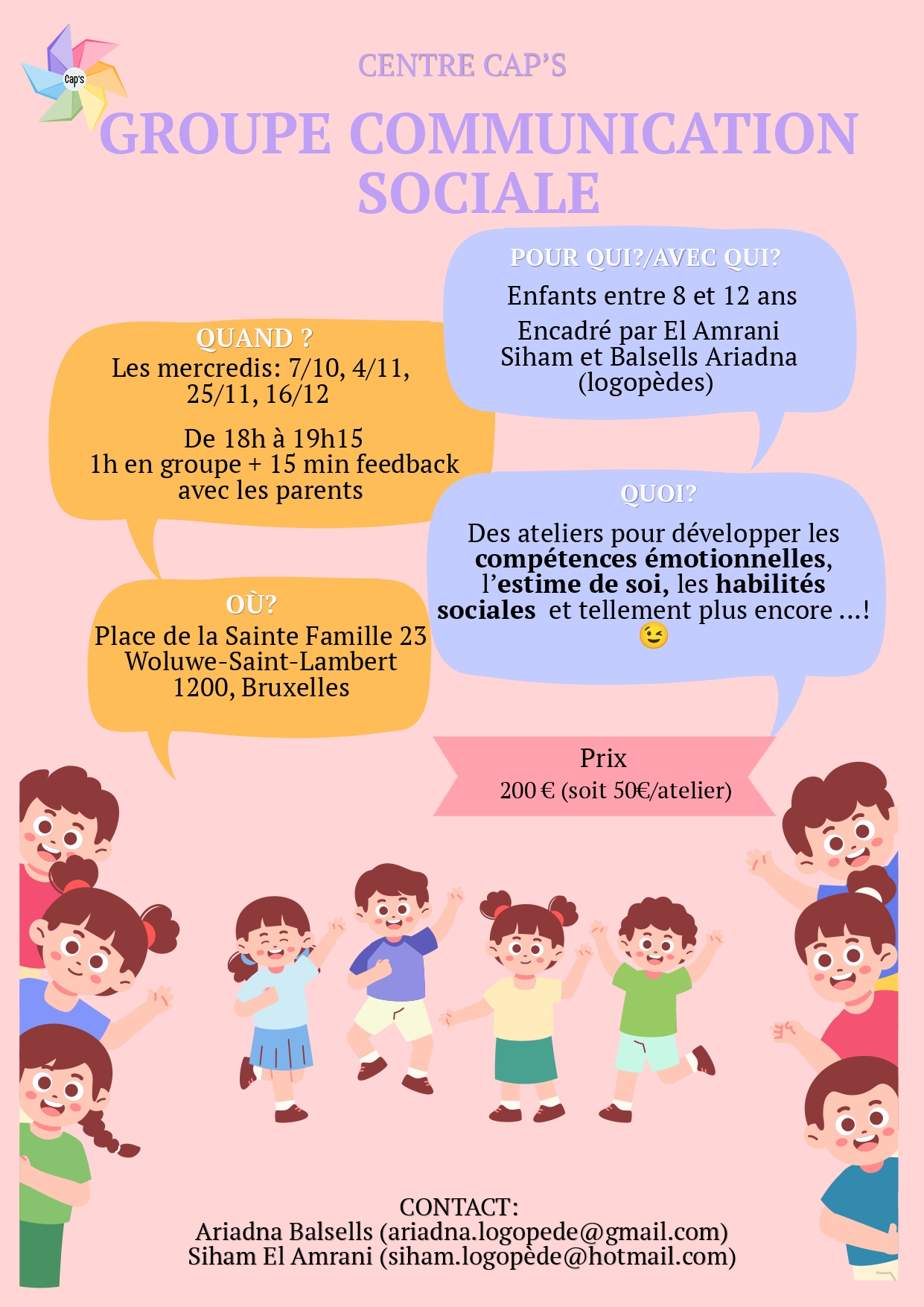
It is with this in mind that my colleague Siham El Amrani and I (Ariadna Balsells) decided to create our social communication groups, for children aged 8 to 12.
We built them around several strands that work together.
Emotions. Recognising what you feel, putting words to it, noticing what the other person feels, and settling yourself when tension rises.
Self-esteem. Many of these children have built up difficult social experiences, sometimes rejection or bullying. Rebuilding the sense of being capable is part of the work.
Concrete social skills. Joining a conversation at the right moment, really listening to the other person, reading nonverbal signals such as eye contact, tone or distance, and adapting how you communicate to the person and the situation.
We deliberately bring together children with similar profiles, whether in the context of an autism spectrum disorder, a developmental language disorder, an attention disorder or another neurodevelopmental condition. This lets them practise with peers, as in real life. Sessions take place on Wednesday, at the end of the day, in a small group and in cycles. Group work and individual follow-up feed into each other, and families are involved at every stage, with clear pointers on what is being worked on so they can support it at home and at school.
If you think one of our groups might suit your child, write to me: we will talk it through together.
Further reading
Gates, J. A., Kang, E., & Lerner, M. D. (2017). Efficacy of group social skills interventions for youth with autism spectrum disorder: A systematic review and meta-analysis. Clinical Psychology Review, 52, 164-181.
Gilmore, R., Ziviani, J., et al. (2022). Social skills group training in adolescents with disabilities: A systematic review. Research in Developmental Disabilities, 125, 104218.
Laugeson, E. A., et al. (2012). The UCLA PEERS® Program: Social skills training for adolescents with autism spectrum disorder. Journal of Autism and Developmental Disorders, 42(6), 1025-1036.
Liratni, M., & Blanchet, C. (2015, 2020). Enseigner les habiletés sociales aux enfants avec autisme (méthode G.A.C.S.). Dunod.